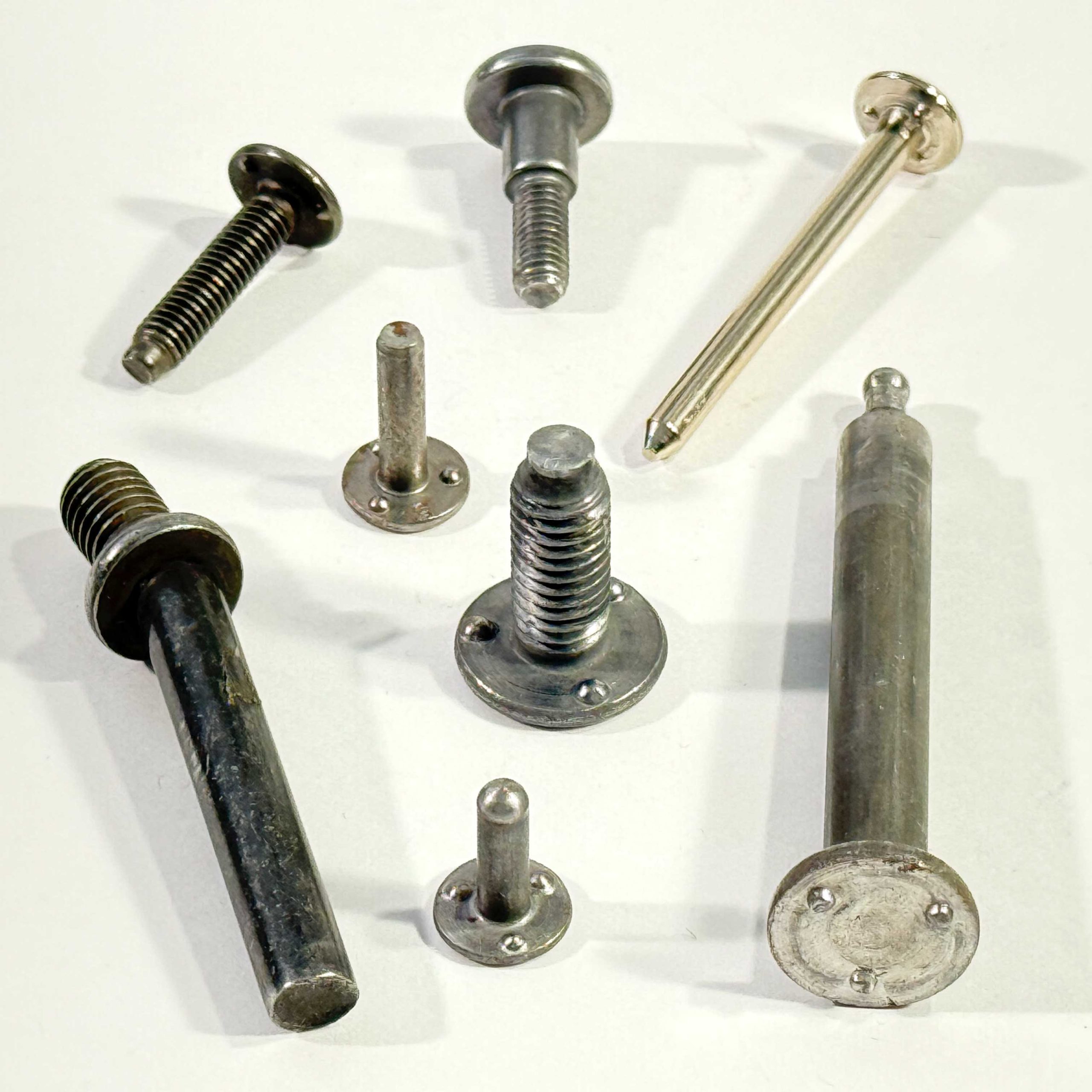
Projection Weld Studs
Projection weld studs often referred to as weld screws are fasteners designed to be permanently attached to sheet metal or structural components using resistance projection welding.
Unlike threaded fasteners installed after fabrication, projection weld studs become part of the assembly during the welding process. Specially formed projections on the head concentrate welding current and pressure, allowing the stud to fuse to the base material while maintaining precise alignment.
These fasteners are widely used in automated manufacturing environments where components must be attached quickly, repeatably, and without backside access.
Projection weld studs are typically application-specific components produced to OEM prints and released against production schedules rather than stocked catalog parts.
Weld Projection Designs
Projection weld studs rely on controlled weld projections formed into the head. These projections concentrate heat and collapse during welding, producing a consistent metallurgical bond between the stud and the base material.
Common projection configurations include:
- Three hemispherical projections under the head
- Three elongated (“sausage”) projections
- Annular ring projections
- Four-point projection patterns
- Central projection designs
Projection patterns may appear either on the underside of the head or on the top surface depending on the welding process and tooling configuration. Because projection geometry directly affects weld current and collapse characteristics, these features are typically defined by the customer’s engineering print rather than by standardized fastener specifications.
Manufacturing Methods
Projection weld studs are most commonly produced by cold heading when volumes justify dedicated tooling. In high-volume production environments—such as automotive manufacturing—these fasteners are typically cold-formed from low-carbon steels such as C1018 through C1022. The weld projections are formed directly during the heading process.
Cold-headed weld studs are commonly supplied against blanket purchase orders with scheduled releases to support ongoing production programs.
When required quantities are smaller, or when projection geometry is not suitable for cold forming, weld studs may also be produced by machining from bar stock. Machined versions allow flexibility when specialized projection shapes or features are required.
Machined weld studs may include:
- Raised circular weld bumps on the top of the head
- Machined annular ring projections
- Projection features located either under the head or on the top surface
- Special pilot noses or location diameters
Machined versions are typically produced from C1018 or C1215 steel depending on machining requirements and weld performance considerations. Although these parts are generally produced in smaller quantities, machining provides a practical solution when production volumes do not justify dedicated heading tooling..
Typical Applications
Projection weld studs are widely used in automated manufacturing where threaded attachment points must be permanently integrated into sheet metal components.
Common examples include:
- Automotive body and chassis assemblies
- Appliance housings
- Electrical enclosures
- Fabricated metal structures
- Industrial equipment panels
Once welded in place, the stud provides a permanent threaded attachment point used during later assembly operations.
How G-Fast Supports These Programs
G-Fast supplies projection weld studs manufactured to approved customer prints.
We commonly support programs where fastener geometry is defined by OEM engineering teams, including automotive manufacturers and other equipment producers. Our role is to review supplied prints for manufacturability, feasibility, and cost efficiency before production begins.
Any suggested changes are reviewed and approved by the customer’s engineering team and incorporated into updated drawings before manufacturing. Because projection weld studs are typically application-specific components, close collaboration between the customer’s engineers and the manufacturing supplier is essential to ensure consistent weld performance.
Typical Configurations
Projection weld studs supplied by G-Fast are commonly produced in several configurations depending on the assembly requirements.
These may include:
- Fully threaded studs
- Threaded studs with unthreaded pilot points
- Unthreaded weld pins
- Studs with special turned noses or pilot features
- Parts with machined shoulders or location features
Many parts incorporate pilot diameters or lead-in geometries intended to control positioning during automated assembly or to guide mating components during later installation operations.
Materials and Finishes
Projection weld studs are most commonly produced from low-carbon steel suitable for resistance welding.
Depending on the application, parts may be supplied:
- Plain (unplated) for optimal welding performance
- Copper plated to improve electrical conductivity during welding
- With secondary finishes when specified by the customer drawing
Material selection and finishing requirements are normally defined directly on the customer’s engineering print.