
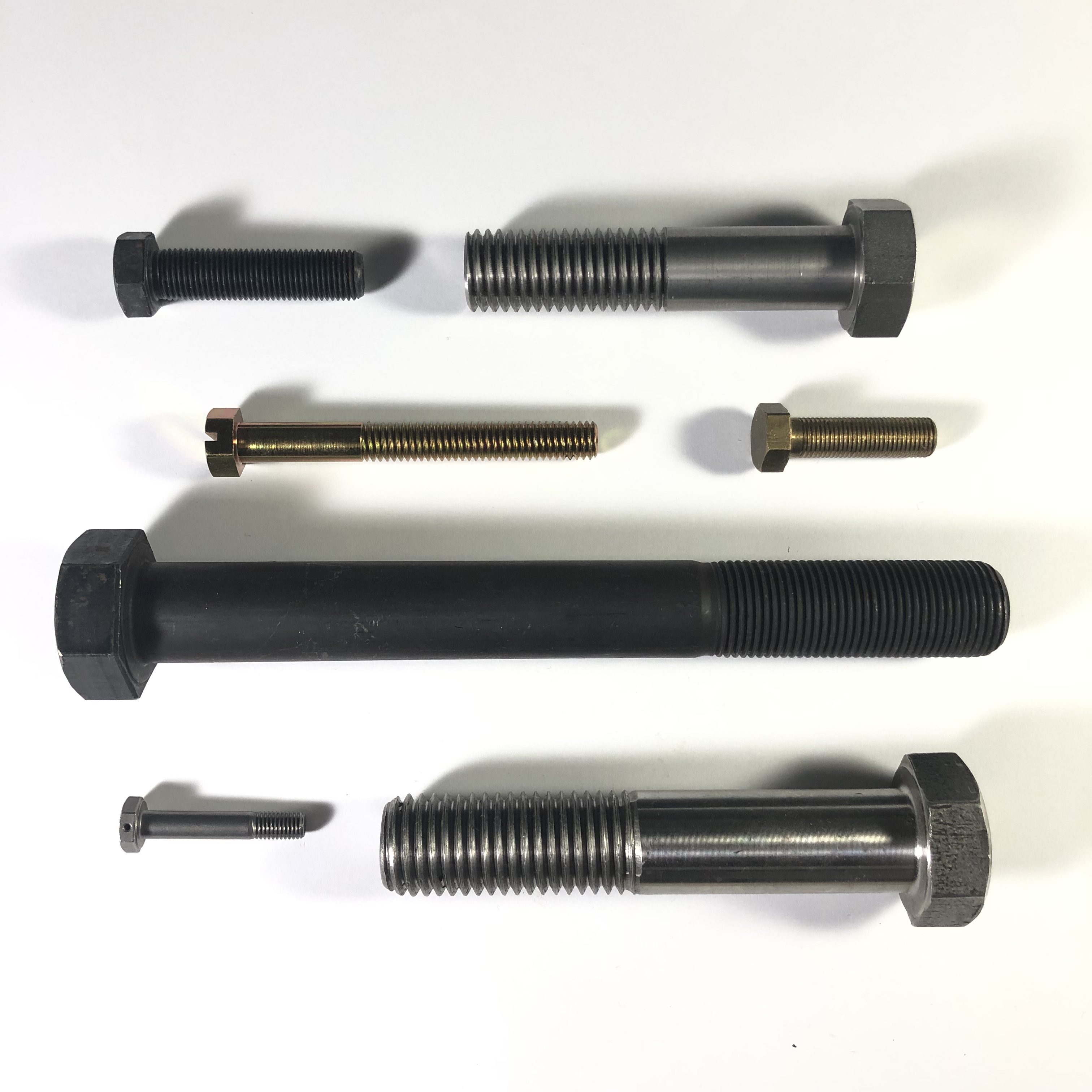
- Head Style: Precision-machined hexagonal finished head with flat bearing surface and chamfered edges
- Material Options: Low carbon steel (Grade A307), medium carbon steel (Grade 5), high-strength alloy steel (Grade 8), 304 stainless steel, 316 stainless steel, brass, silicon bronze
- Thread Types: Unified National Coarse (UNC), Unified National Fine (UNF), 8-UN, and metric ISO thread pitches
- Size Range: 1/4″ to 2-1/2″ diameter; 1/2″ to 12″ length (custom sizes available)
- Finishes: Zinc plating (clear, yellow, black), hot-dip galvanization, mechanical galvanization, black oxide, cadmium plating, and plain finish
- Strength Ratings: Tensile strength from 60,000 psi (Grade A307) to 150,000 psi (Grade 8)
- Proof Load Values: 33,000 psi (Grade 2), 85,000 psi (Grade 5), 120,000 psi (Grade 8)
- Standards Compliance: ASME B18.2.1, ASTM A307, ASTM A325, ASTM A490, SAE J429, ISO 4014, ISO 4017, DIN 933, DIN 931
- Description
- Features
Finished hex bolts are essential fasteners designed for strength, precision, and durability across industrial, construction, and mechanical applications. Manufactured with advanced metallurgical engineering and refined machining, these bolts deliver superior torque performance and consistent clamping force. The “finished” designation indicates a precision-m achined head and bearing surface, ensuring a smooth fit, uniform load distribution, and optimal joint integrity.
Ideal for professionals in construction, automotive, manufacturing, and maintenance sectors, finished hex bolts provide a secure and efficient solution for fastening components under high stress. Their six-sided head design allows effective wrench engagement, minimizing slippage and head rounding even under high torque conditions. These bolts are widely used in steel structures, machinery assembly, bridge construction, and heavy equipment manufacturing.
Typical Applications
- Structural steel frameworks
- Bridge construction
- Automotive and machinery assembly
- HVAC and plumbing systems
- Marine and heavy equipment manufacturing
- Six-point hex head provides superior torque control and prevents tool slippage.
- Precision-machined bearing surface ensures even load distribution and enhanced bolt tension.
- Available in heat-treated grades for excellent strength-to-weight performance in demanding environments.
- Wide material selection, including carbon steel, alloy steel, stainless steel, brass, and silicon bronze.
- Corrosion-resistant finish options for outdoor and marine applications.
- Compatible with standard hex nuts, lock washers, and flat washers.
- Supports pneumatic and electric wrench installation for fast assembly in production lines.