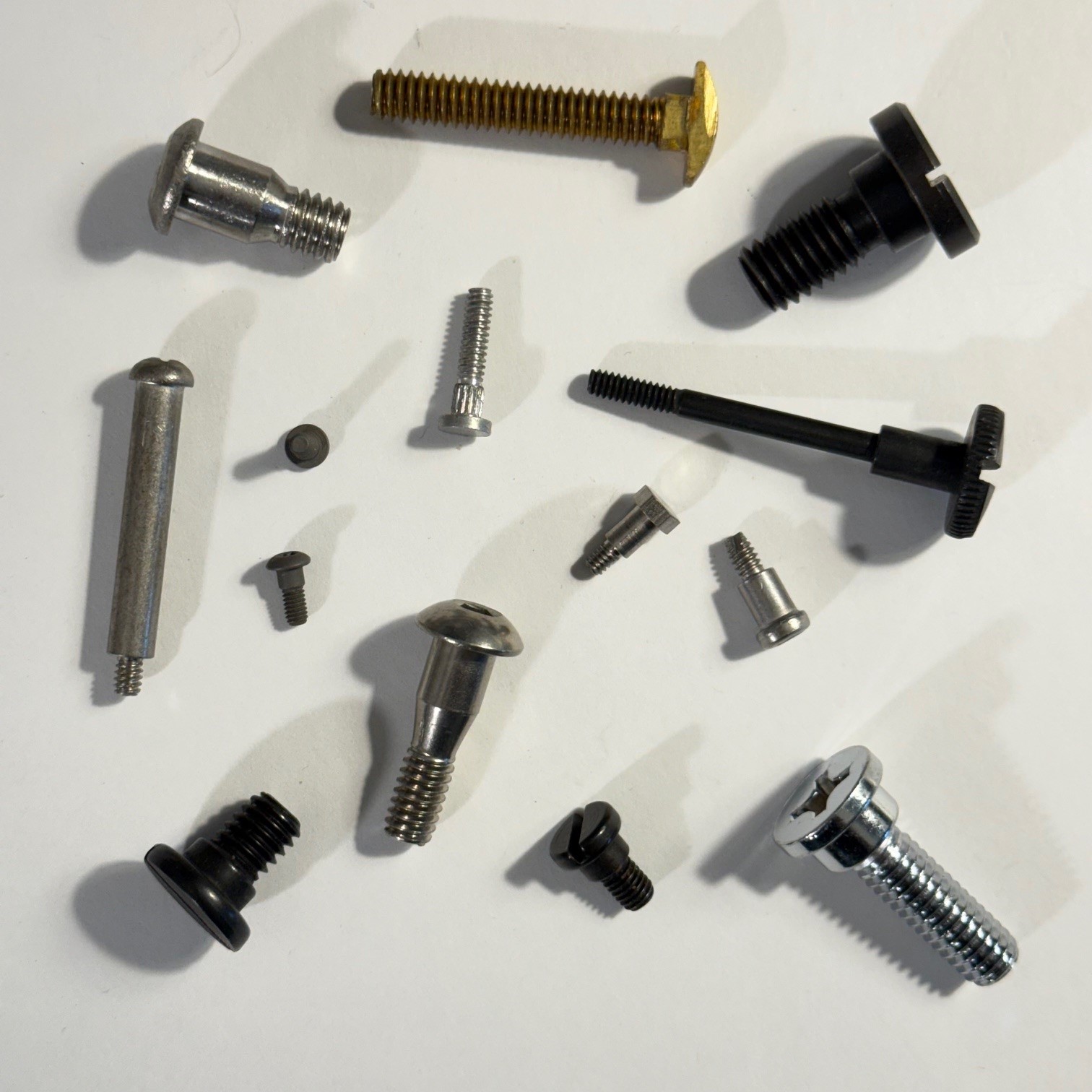
Shoulder screws are precision fasteners designed to perform both a fastening function and a mechanical function within an assembly. Unlike fully threaded screws, they incorporate an unthreaded shoulder section that acts as a controlled bearing surface, pivot point, spacer, or alignment feature.
In many applications, the shoulder is the primary functional element. The threaded portion simply secures the assembly in place.
While standardized socket shoulder bolts represent one subset of this category, shoulder screws more broadly include application-specific geometries defined directly by customer drawings.
Beyond Standard Socket Shoulder Bolts
Socket shoulder bolts typically follow standardized dimensional specifications and are used where catalog geometry meets the application requirement.
Shoulder screws, by contrast, often incorporate press-fit or partial interference features, modified head diameters or profiles, extended or reduced pilot sections, controlled underhead transitions, custom thread lengths, and integrated geometry for springs, linkages, or stamped components.
In motion-driven systems, these features influence wear rate, rotational smoothness, and long-term reliability.
Motion Control and Load Transfer
The shoulder section typically carries shear and rotational load while the threaded section maintains axial retention.
Because the shoulder often interfaces with bearings, bushings, stamped components, springs, or linkages, dimensional control, surface finish, and concentricity directly impact performance.
In some designs, shoulder screws function as pawl pivots, actuation pins, spacing elements, or rotational shafts within compact mechanisms. In these cases, the fastener behaves more like a machine component than a standard screw.
Geometry and Tolerance Considerations
Shoulder diameter and length are typically controlled to meet application-specific requirements. Standard commercial tolerances may be sufficient in some assemblies, while tighter control is defined directly on the print in motion-sensitive systems.
Material selection, heat treatment, and surface condition are likewise driven by wear characteristics, environmental exposure, and load cycles.
Because these components frequently operate in shear and rotation, manufacturing process control is critical to ensure repeatable fit and long service life.
When Standardized Shoulder Bolts Are Appropriate
If the application falls within standard dimensional tables, does not require special underhead features, does not incorporate press-fit or modified geometry, and operates within common commercial tolerances, a standardized socket shoulder bolt may satisfy the requirement.
When the Component Becomes Print-Defined
Applications involving press-fit features, spring engagement geometry, integrated motion components, controlled stack-up management, or modified drive styles typically move beyond catalog parts and into print-defined shoulder screws.
At that point, the fastener is no longer selected—it is specified.
How G-Fast Fits In
G-Fast supports OEM and industrial customers working from approved prints for both standardized and application-specific shoulder screws.
We review drawings for manufacturability, feasibility, cost efficiency, and process compatibility. We do not redesign assemblies or modify specifications without engineering approval.
In many motion-driven applications, proper review of the shoulder geometry is more critical than the thread itself.
Closing Perspective
Shoulder screws occupy a unique position between fasteners and functional machine components. In standardized form, they provide reliable spacing and pivot control. In application-specific form, they become integral elements of the mechanism itself.
Understanding that distinction ensures the right component is specified for the job.