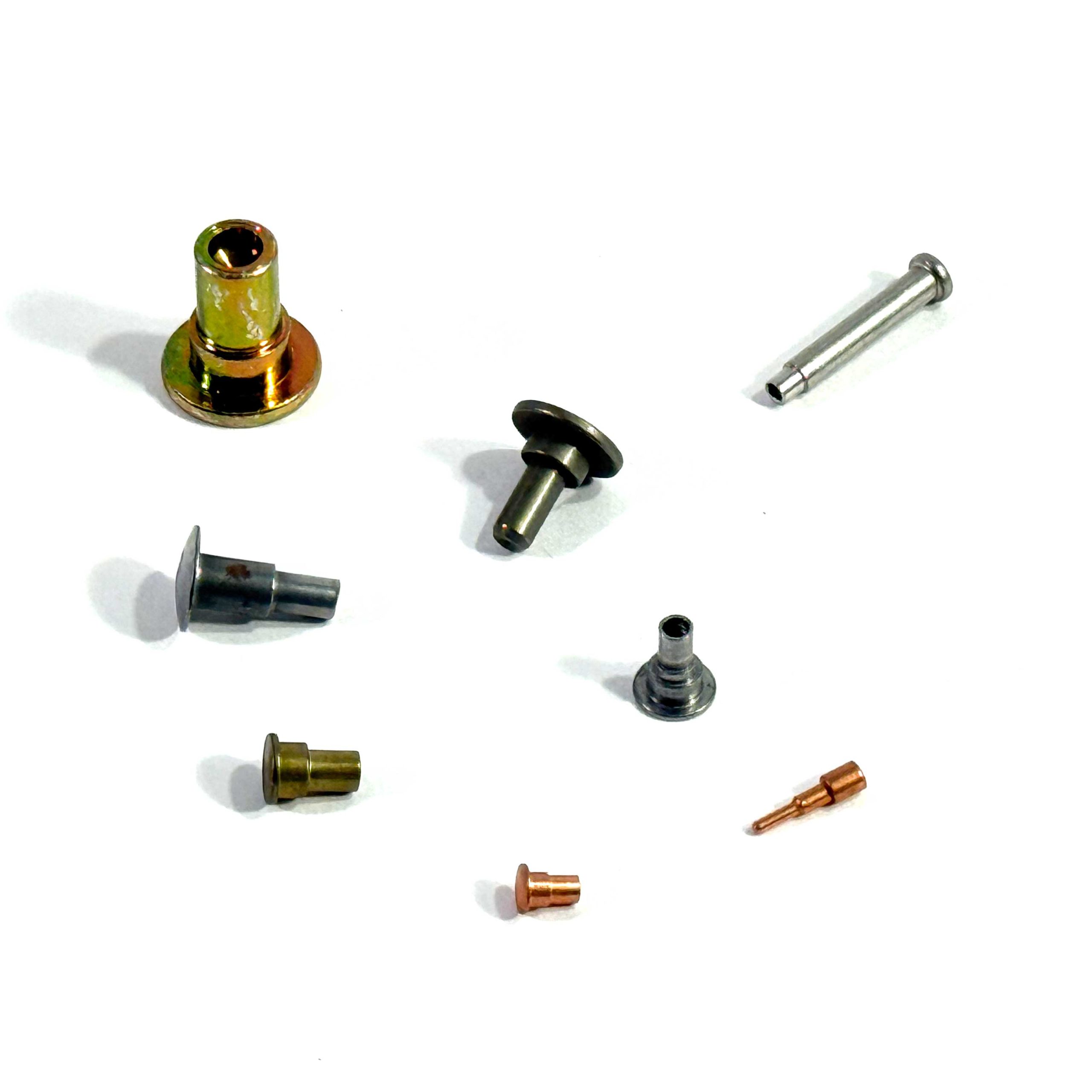
Shoulder rivets are precision fasteners designed to control alignment, spacing, and rotational clearance within an assembly. A cylindrical shoulder between the head and shank provides a defined bearing surface that establishes stand-off distance and, in pivoting applications, governs fit and movement. These specialized fasteners are commonly specified where controlled spacing, alignment, or rotational movement is required.
Shoulder rivets are defined by geometry rather than shank construction. They may be manufactured in either solid or semi-tubular configurations depending on the shoulder rivet installation method, assembly requirements, and forming considerations. Shank construction should be specified as part of the complete part definition to ensure the rivet is compatible with the intended installation process.
G-Fast supplies shoulder rivets through qualified domestic and global sources and supports specification verification and production blanket programs for industrial and OEM applications.
Understanding Shoulder Rivet Geometry
Each dimension of a shoulder rivet directly affects assembly performance. A shoulder that exceeds bore tolerance will not assemble; an undersized shoulder introduces clearance and potential play. All dimensions should be confirmed against the assembly drawing prior to order placement.
| Dimension |
Function Controlled |
Specification Guidance |
| Shoulder Diameter |
Fit with mating bore; controls rotation and alignment |
Match to bore tolerance; specify fit class for rotating applications |
| Shoulder Length |
Axial spacing between mating faces |
Must match total stack-up at installation point |
| Head Diameter & Style |
Bearing surface and driven-side geometry |
Confirm head style meets clearance and appearance requirements |
| Shank / Tail Diameter |
Solid or semi-tubular section below shoulder |
Specify construction and size to peen cleanly without deforming shoulder or head |
Typical shoulder diameter tolerances may range from close precision fits to general-purpose clearances, depending on application requirements. Fit class should be specified where rotational or sliding movement is required.
Common Applications of Shoulder Rivets
- Pivot points in mechanical linkages and lever assemblies
- Cam followers and timing mechanisms
- Instrument and control panel stand-off mounting
- PCB and electronic assembly spacer-fasteners
- Assemblies requiring a captive, dimensionally accurate bearing surface
Supply & Fulfillment Options
- Production blanket orders and scheduled releases
- Specification review prior to order placement
Request a Quote
Shoulder rivets are precision components. Complete specifications prevent costly errors. Provide the following for accurate pricing and lead time:
- Existing part number (if applicable) with print or drawing reference
- Shoulder diameter and shoulder length
- Head style
- Shank diameter and overall length
- Material and finish
- Fit requirement at shoulder bore (clearance, transition, or interference)
- Estimated annual usage
- Print or sample
To evaluate availability or submit a specification, request a quote through the website.
Head Style Options of Shoulder Rivets
Shoulder rivets are commonly available with flat or binding head configurations. Flat heads provide a low profile; binding heads offer increased bearing surface. Countersunk shoulder rivets are available where the access-side surface must be flush; confirm countersink angle matches head angle specified.
Shoulder Rivets Material Options
Shoulder rivets are typically produced to print and are available in a range of materials depending on load, wear, and environmental requirements:
- Low Carbon Steel (plain or plated)
- Alloy Steel
- Stainless Steel (including 302 and 410)
- Aluminum
- 260 Brass
- Bronze
- Titanium
Surface hardness and finish should be evaluated for rotating or oscillating applications. Material compatibility with the mating bore should be considered to minimize wear and galvanic interaction.