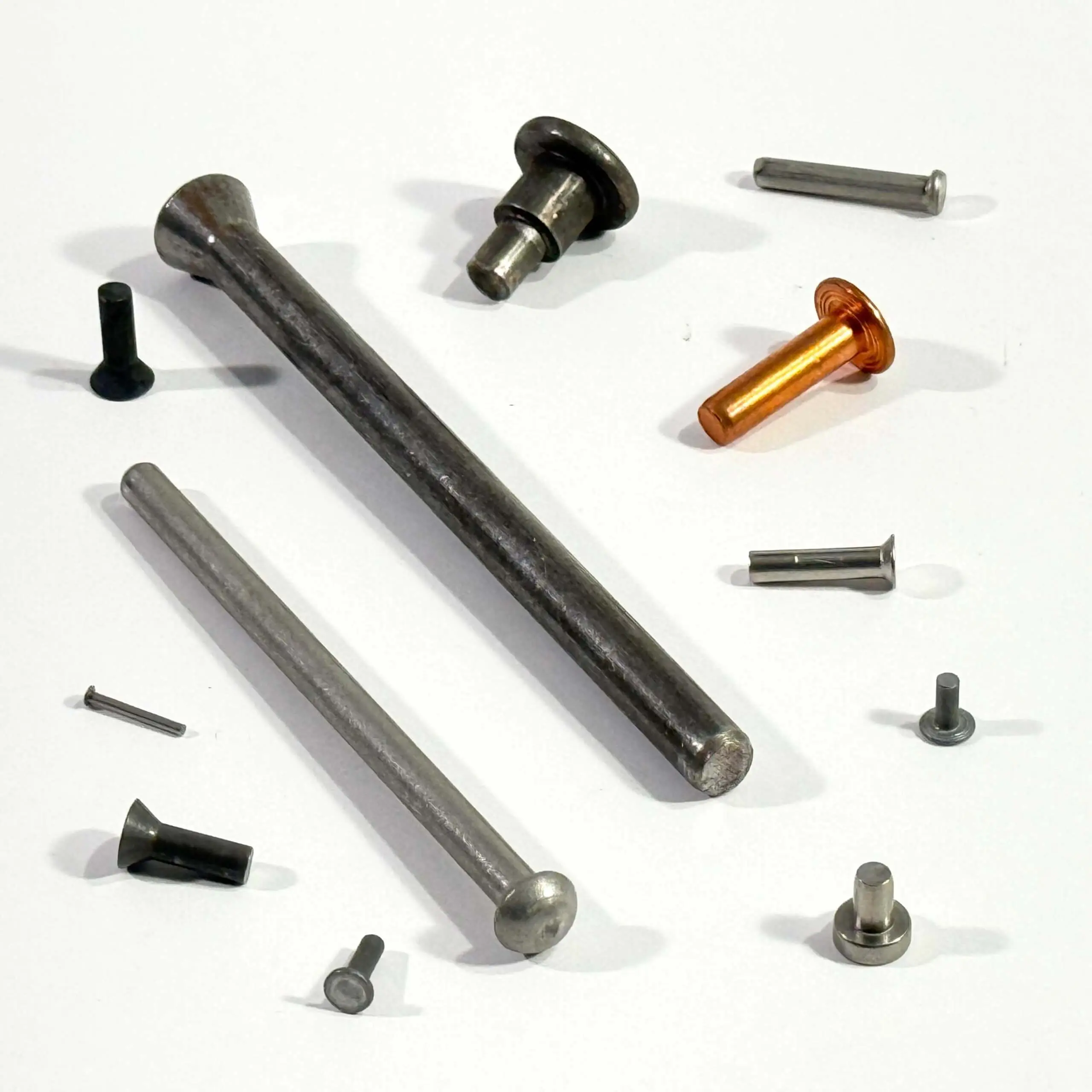
Solid rivets are permanent fasteners installed by upsetting the tail end of the shank to form a shop head. When properly specified and installed, the full shank cross-section contributes to load transfer, providing long-term joint stability and resistance to vibration.
Installation requires access to both sides of the assembly. Solid rivets are selected where permanence, controlled deformation, and consistent mechanical performance are required.
G-Fast supplies solid rivets through qualified domestic and global sources. We support specification verification, part number cross-referencing, and production blanket programs for industrial customers.
Installation and Joint Characteristics
Solid rivets are formed during installation by upsetting the tail to create a shop head. Proper installation technique and length selection are critical to ensure correct head geometry and full joint integrity.
Because the entire shank cross-section remains intact prior to forming, solid rivets provide consistent load distribution when properly sized and installed.
Supply & Fulfillment Options
- Production blanket orders and scheduled releases
- Specification review prior to order placement
Request a Quote
Provide the following for review:
- Existing part number (if applicable) with print or drawing reference
- Diameter and overall length
- Head style
- Material and alloy designation
- Finish or plating requirements (if any)
- Estimated annual usage
- Print or sample
To evaluate availability or submit a specification, request a quote through the website.
Head Style Options
| Head Style |
Typical Application |
Key Consideration |
| Universal (Round) |
General structural and industrial assemblies |
Protruding head — verify clearance |
| Flat (Countersunk 100°) |
Flush surface requirements |
Requires precise countersink preparation |
| Pan |
General assembly where lower profile is preferred |
Moderate bearing surface |
| Truss (Mushroom) |
Thin or softer materials |
Wide bearing area |
| Button |
Appearance-sensitive or specialty assemblies |
Rounded profile |
Material Options
In addition to the materials commonly used for semi-tubular rivets, solid rivets are available in a broad range of alloys:
- Low Carbon Steel (plain or plated)
- Alloy Steel
- Stainless Steel (including 302 and 410)
- Aluminum (2017-T4, 2024-T4, 5056)
- 260 Brass
- Copper
- Titanium
- Alloy 60
- Bronze
- Monel
Alloy selection significantly affects strength, ductility, corrosion resistance, and installation behavior. Material compatibility with mating components should be evaluated to minimize galvanic interaction, particularly in dissimilar-metal assemblies or outdoor environments.
Diameter and Overall Length
Solid rivets are commonly supplied in diameters ranging from 1/16 inch through 5/16 inch, depending on material and head style.
Overall length must account for total material stack thickness plus sufficient material to form a proper shop head during installation. Incorrect length selection can result in incomplete or oversized head formation and reduced joint performance.
Larger diameters or specialty configurations may be reviewed on a case-by-case basis based on specification and production source.