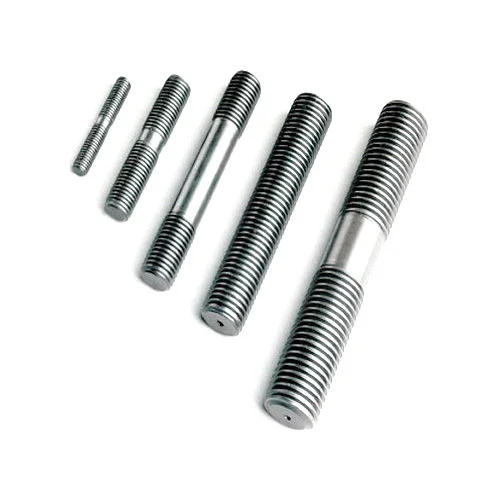
G-Fast manufactures precision double end threaded studs in both standard and custom configurations for industries including pressure vessels, automotive, aerospace, and industrial OEM applications.
What Is a Double End Stud?
A double end threaded stud consists of three distinct zones: a threaded section on one end (the "stud end" or "plant end"), a plain unthreaded shank in the center, and a threaded section on the opposite end (the "nut end"). The two threaded sections can be the same length and pitch, or they can be different each specified based on its function in the assembly.
This is the critical distinction from a fully threaded stud. A double ended stud bolt is designed so that the two ends serve different roles. The stud end is typically threaded into a tapped hole or fitted component and remains fixed during assembly. The nut end is then used to draw the mating part against the assembly, torqued from outside with a nut. This configuration prevents thread galling in the tapped hole during repeated assembly and disassembly a significant advantage in high-cycle or high-torque applications.
Key Applications
Pressure Vessels & Flanges Used in heat exchangers and flanged connections for secure, non-rotating fastening and accurate load distribution.
Pump & Compressor Systems Ideal for maintenance-heavy equipment where repeated assembly/disassembly occurs.
Automotive & Powertrain Common in cylinder heads, manifolds, and exhaust systems to improve durability and thread life.
Industrial OEM Equipment Used in conveyors, gearboxes, and hydraulic systems where alignment and consistent clamping are critical.
Why Double End Studs Outperform Bolts in Permanent Stud Applications
The question engineers often ask is: why use a double ended stud bolt when a standard bolt will technically fit? The answer comes down to three factors: thread protection, assembly repeatability, and alignment accuracy.
- Thread Protection: When a bolt is repeatedly threaded into and out of a tapped hole, it wears both the bolt threads and the tapped hole. A permanently installed stud end eliminates this wear cycle. Only the nut is ever removed, preserving the tapped engagement indefinitely.
- Assembly Repeatability: With both end threaded studs already installed, the mating component can be guided onto the protruding nut ends before any torque is applied. This improves alignment control during assembly critical for gasketed or precision-fit joints.
- Torque Accuracy: Because the stud end is fixed and only the nut rotates, the fastening torque is entirely translated into clamping load rather than being partially consumed by friction at the stud end. The result is more accurate and consistent bolt load in the joint.
When to Choose a Double End Stud vs. a Fully Threaded Stud
The decision between a double ended stud bolt and a fully threaded stud comes down to the nature of the joint. Use a double end stud when:
- One end will be permanently installed into a tapped hole in the mating component
- The assembly will be repeatedly disassembled and reassembled during service or maintenance
- Precise alignment of mating parts during assembly is required
- The application is governed by a standard (e.g., ASME B16.5) that specifies stud bolt configuration
- Higher clamping load accuracy is needed than a bolt can deliver due to friction effects
Choose a fully threaded stud when you need adjustable engagement depth, when both ends will accept nuts, or when the fastener functions as a tie rod or hanging rod rather than a planted stud-and-nut assembly.
Need Double End Studs for Your Application? Request a Quote or Discuss Specifications with G-Fast Today.
Reach out to G-Fast's engineering sales team with your drawing, specification, or application description. We'll help you select the right stud end configuration, material, and quantity and deliver on time, to spec, every time.