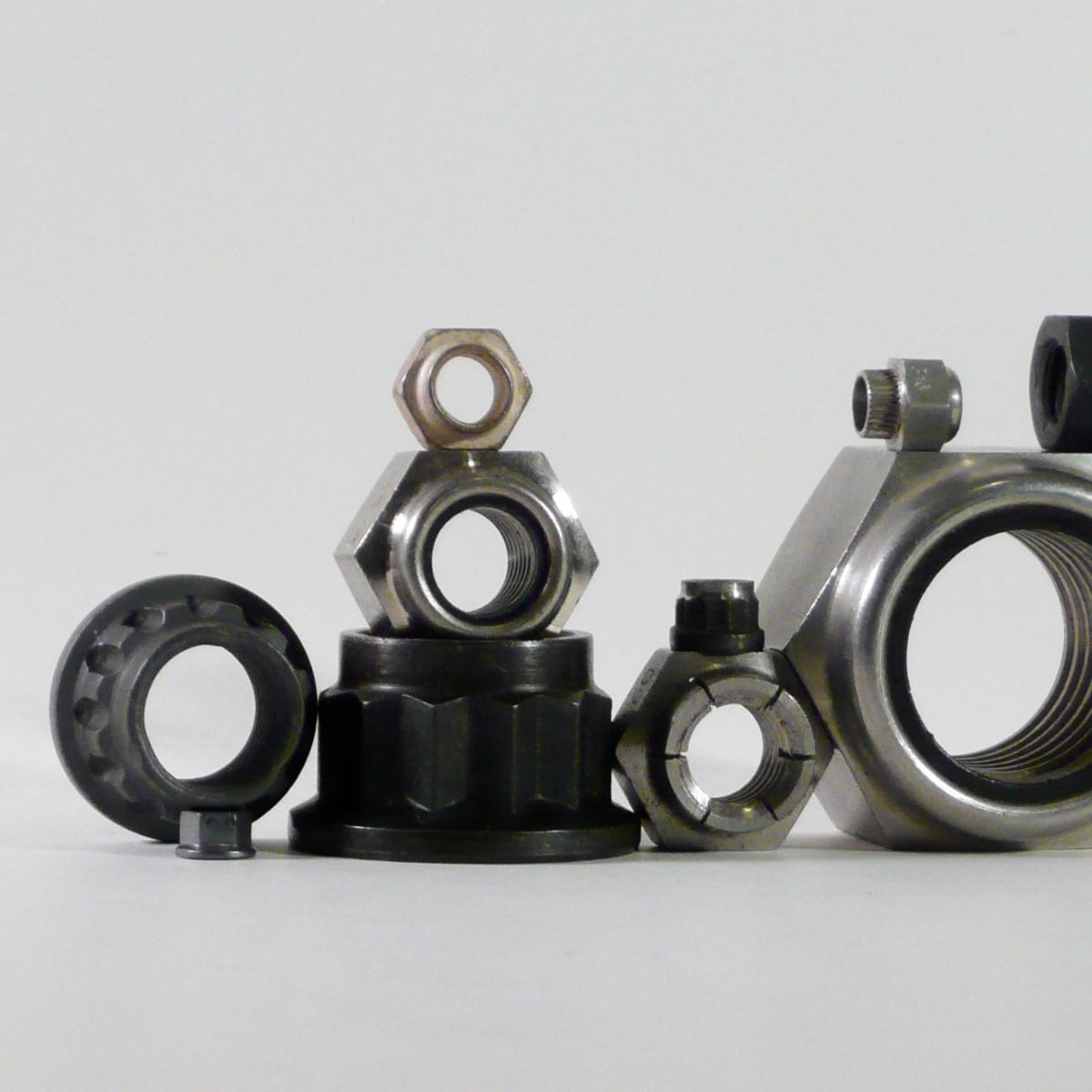
Self-Locking Nuts - Primary Locking Categories
Nylon Insert (Non-Metallic Locking Element) Lock Nuts
Nylon insert locknuts incorporate a polymer ring positioned at the top of the nut. During installation, the mating bolt displaces the insert elastically, creating prevailing torque through frictional interference.
These are commonly used in commercial and industrial applications and are suitable within defined temperature limits. Commercial quality self-locking nuts are manufactured and tested to meet the requirements of IFI-100/101. When certification is requested, documentation can be supplied in accordance with the applicable standard.
All-Metal Prevailing Torque Lock Nuts
All-metal locknuts achieve locking action through controlled deformation of the nut body or thread form. Common designs include top-lock (elliptical deformation), side-lock, and other distorted-thread configurations.
Because no polymer insert is present, all-metal locknuts are specified in elevated temperature, aerospace, and military environments. Aerospace specifications such as MS, NAS, and MIL standards may require prevailing torque performance to be verified over fifteen installation and removal cycles
Standard vs. Print-Specific Supply
Many self-locking nuts are available to established dimensional and performance standards through qualified distributor and manufacturer channels. Where customer drawings specify special materials, non-standard finishes, modified geometry, or unique prevailing torque requirements, supply becomes print-specific.
G-Fast reviews specifications for availability, manufacturability, feasibility, and cost efficiency based strictly on approved customer documentation. G-Fast does not perform product design services.
How G-Fast Supports Your Requirements
G-Fast supplies commercial and aerospace self-locking nuts in accordance with applicable IFI, ISO, MIL, and NAS specifications. We coordinate required documentation and certification through qualified manufacturing sources and support both standard and print-specific sourcing.
To evaluate availability or submit a specification, request a quote through the website.
Thread Gaging Considerations
All-metal self-locking nuts incorporate an out-of-round locking zone. As a result, thread gaging differs from free-spinning nuts. Specifications often define minimum free-turn requirements prior to engagement of the locking element. Thread inspection is typically performed after plating or finishing in accordance with governing standards.
Materials and Finishes
Self-locking nuts are manufactured from carbon steel, alloy steel, stainless steel, and specialty alloys depending on strength, corrosion resistance, and temperature requirements.
Finishes may include zinc or cadmium plating, mechanical or hot-dip galvanizing, phosphate coatings, organic coatings, silver plating for high-temperature applications, and dry film lubricants for torque control and anti-galling performance.
Commercial vs. Aerospace Requirements
| Characteristic |
Commercial (IFI) |
Aerospace / Military |
| Typical Cycle Requirement |
5 installation/removal cycles |
15 installation/removal cycles |
Certification and Inspection
For government or aerospace drawings (MS, NAS, MIL), components are supplied with required documentation in accordance with the governing specification. This may include material certifications, heat treat certifications, plating or process certifications, and applicable test reports when specified.
Depending on the governing specification, additional inspection or testing may be required, including magnetic particle inspection (MPI), metallographic evaluation, hardness verification, grain size analysis, or other specified material and process validation tests. Documentation is supplied in accordance with approved customer requirements.